Right off the bat I've got to say that for a debut novel, Pete Kahle has shown us that he knows what the hell he's doing. I haven't read a debut this strong in years. It's astonishing what he managed to do in this tome with character development and a plot that is told in a nonlinear format that most authors take years of novel writing to develop. Bravo, Pete!
So, The Specimen is a story about parasitic entities called Riders that, throughout human history, have been latching onto various people, living within them, and causing a great deal of bloodshed. There is a secret agency out to destroy the alien race of Riders, and have been doing so for many years, but their collective has corruption of its own. There's so much in this story that I can't even begin a good synopsis without spoilers, so I'll leave it at that.
The character development in this story is as rich and detailed as a Stephen King or Robert McCammon novel with visceral violence and gore that leans to the extreme in its vivid detail. Blood and body fluids abound! I found it interesting early in the story when a couple of guys were called "your typical goon", which I thought was a bad descriptor, until I realized that was a way of saying, hey, there are so many richly detailed characters in this book that these guys, who are only in the story for a few pages, are just a couple of red shirts. believe me, there's no lack of detail concerning the characters who matter to the story. They live. They breathe.
Now, I'm not a huge fan of massive tomes. They tend to feel padded and under-edited. I think this book could have been dialed down just a bit. There are a ton of sub-plots going on and the time-line jumps around a lot. It all makes sense and wasn't confusing at all, but I found the present day material to be the most interesting, and really the heart of the story. I think a lot of the story that was told through reports from the Graylock Institute (I may have flubbed the name there) could have been weaved into the narrative and completely eliminated, but that's just probably just me trying to slim down a novel that gives a great pleasure to people who like to sit down with that huge six-hundred-pager and commit for a while. I also think the intermissions (read the book to find out what I'm talking about), which gives the story nice historical context, were ultimately unnecessary. In fact, during the climax it is all summarized in a few paragraphs. The intermission chapters were well written, but I think they could have been pulled from the manuscript and used as promotional tools on a website or Patreon page or something. But who am I to suggest such a thing? Pete Kahle has done very well with this book, getting a shout-out recently from Brian Keene and earning almost 200 reviews on Amazon (that's fucking astonishing for both a debut novel and a small press author).
lastly, I listened to the audiobook version of the book, so I would be remiss to not mention a bit about that experience. First off, the narrator did a fantastic job. There were a number of accents that he nailed with convincing accuracy, which is so important. That gives the narrative movement and theater. No one wants to slog through an otherwise good book that feels like a sluggish monologue. Also, there were sound effects here and there that really added to the experience. They were used sparingly and were quite effective, making for a fun and entertaining experience.
Look, I know what Pete is doing with Bloodshot Books is important, but he needs to get another novel out there. I absolutely love reading new authors that are the real deal, and Kahle has got the goods. I highly recommend reading The Specimen, or better yet, listening to the audiobook (yes, the highlighted words are links).
Next up is Catacombs by Andrew Laurance, originally published under the title The Hiss. See ya then!
Monday, February 26, 2018
Wednesday, February 21, 2018
Thoughts on Paperbacks From Hell
The non fiction book of 2017 was Paperbacks From Hell by Grady Henrix, hands down. Not that I read a whole lot of non fiction in 2017. I just can't see something else that's better than a book about mass market paperback from the seventies until the crash in the nineties, loaded with colorful pictures of cover art, sublime and glorious. If nothing else, I imagine this book has and will continue to reinvigorate people's fondness for long lost paperbacks that have been relegated to used book stores, thrift shops, and library book sales. Some of them have been terribly mistreated, probably considered a slice of schlock that wasn't worth preservation. I have plenty that were used as door stops and bent and torn and probably thrown across a room a time or two (I can only imagine how previous owners treated some of the books in my collection). Covers taped on, spines so cracked you can hardly read the title much less the author's name. But the words are still there on the pages (if they're not falling out), and thus the story can be read, for better or worse. Some of those old books are great (Michael McDowell's The Elementals and T. M. Wright's Strange Seed are recent gems I've read), and others are utter trash (William W. Johnstone's The Devil's Kiss fits nicely in this category). Paperbacks From Hell covers it all, with brief summaries of certain titles, interesting factoids about certain authors, and even insight on some of the cover artists that brought us all those amazing creatures, skeletons, demons, evil children, native spirits, and devils that popped in embossed foil, holograms, and step-back art.
I savored this book slowly since getting it for Christmas. I didn't want to just blow through it. I lingered on the cover art, following paint brush strokes and skeleton faces, baby dollies and evil entities. The book is written with a nice dose of humor and sarcasm that could only come from someone who truly appreciates the subject matter. Hendrix has obviously read a great deal of the books (probably pored over them while writing the book and probably sick to death of embossed skeletons by the time he was finished). Putting a book like this one together is clearly a labor of love, and the insight on the titles that are summarized come from more than just reading the back cover copy.
My guess is that finding autobiographical info on the more obscure authors who graced paperback racks back in the seventies and eighties is pretty difficult. I could have done with more of that. I found the little biographical tidbits fascinating. I think there should be a companion book that focuses on some of the more prolific authors of the time, as well as the cover artists. A few authors and cover artists are highlighted, but there are plenty more, and I for one would be fascinated to learn more.
If you're a horror fan and you don't have this book, shame on you. You can purchase it HERE, and though there is an ebook available, do yourself a favor and pick up the physical version. It's full-color and well worth the investment.
That's all for now. Next up is Pete Kahle's The Specimen. I've already finished it, so those thoughts will be posted soon.
I savored this book slowly since getting it for Christmas. I didn't want to just blow through it. I lingered on the cover art, following paint brush strokes and skeleton faces, baby dollies and evil entities. The book is written with a nice dose of humor and sarcasm that could only come from someone who truly appreciates the subject matter. Hendrix has obviously read a great deal of the books (probably pored over them while writing the book and probably sick to death of embossed skeletons by the time he was finished). Putting a book like this one together is clearly a labor of love, and the insight on the titles that are summarized come from more than just reading the back cover copy.
My guess is that finding autobiographical info on the more obscure authors who graced paperback racks back in the seventies and eighties is pretty difficult. I could have done with more of that. I found the little biographical tidbits fascinating. I think there should be a companion book that focuses on some of the more prolific authors of the time, as well as the cover artists. A few authors and cover artists are highlighted, but there are plenty more, and I for one would be fascinated to learn more.
If you're a horror fan and you don't have this book, shame on you. You can purchase it HERE, and though there is an ebook available, do yourself a favor and pick up the physical version. It's full-color and well worth the investment.
That's all for now. Next up is Pete Kahle's The Specimen. I've already finished it, so those thoughts will be posted soon.
Tuesday, February 13, 2018
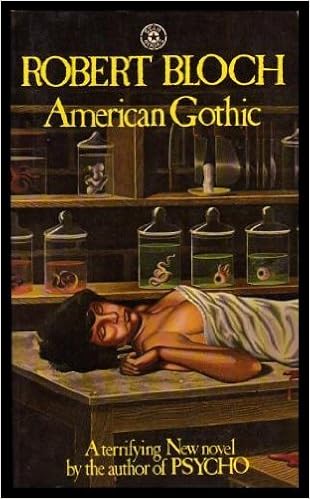
Thoughts on American Gothic by Robert Bloch
I'm a huge fan of Robert Bloch. He was one of the absolute best writers of short stories ever. King of the twist ending and able to develop a character in a paragraph or less. I read a ton of his short fiction before I ever read one of his novels. My first was Lori, and it's a good one. Lori is one of those reads that even someone like me who is a dreadfully slow reader can get through in one day. The man just knew how to structure sentences for maximum readability, something that was probably spawned from the economy of words in his short fiction. I've since read a number of Bloch's novels and the latest was American Gothic. These are a few of my thoughts.
First off, it was clear from the first page or two that this was a story based in part on the notorious serial killer H. H. Holmes. The villain's name is G. Gordon Gregg and we quickly discover that he has built a castle in Chicago with quite a number of rooms as well as staircases that lead to secret passage ways and doors that blend into walls. H. H. Holmes hired several contractors to build portions of his mansion using separate plans so no one but himself would know about the secret passages and whatnot. Fascinating stuff, so it's no surprise that Bloch decided to render a fictional account of the infamous H. H. Holmes and wrap it up in a mystery. There's an afterward entitled Post Mortem in which Bloch explains a bit about Homes and the inspiration for American Gothic.
The story itself was very much a mystery like the early Bloch material such as The Scarf, The Couch and Psycho, only this one was a historical piece. The characters were well drawn and he certainly didn't beat the reader over the head with the fact that is was the late eighteen hundreds, which is something that often happens with period pieces. I do have to say that when reading Robert W. Chambers, who was alive and writing close to the time this story took place, his work in many of the stories in The King in Yellow are so fully drenched in the stagnant alleyways and unpaved avenues of New York that you can't help but feel like you are right there in another time. Though you don't ever forget the time period in which American Gothic takes place, I felt that the presence of time could have been a little richer.
I like the protagonist, Crystal, a go-get-'em journalist who risks life and limb to break a story no one has faith in. She has to take seriously desperate measures and essentially she's working on a hunch. I can't help but see in her a character I wrote a in an unpublished novella and an unpublished novel. My investigative journalist, Veronica Hensley, is Crystal reincarnated, only she deals with modern menaces both human and inhuman.
There's no real motive for why G. Gordon Gregg does what he does (some kind of absurd romanticism as shown in his collection at the end of the story?), but who cares? Do we always have to have a reason? It's not like he was going to make some confession in the last chapter when he's getting doused with his own flesh dissolving chemicals and stabbed with his own knife. Just accept that G. Gordon Gregg is a goddamned vicious psychopath (a specialty of Robert Bloch), and enjoy the ride.
First off, it was clear from the first page or two that this was a story based in part on the notorious serial killer H. H. Holmes. The villain's name is G. Gordon Gregg and we quickly discover that he has built a castle in Chicago with quite a number of rooms as well as staircases that lead to secret passage ways and doors that blend into walls. H. H. Holmes hired several contractors to build portions of his mansion using separate plans so no one but himself would know about the secret passages and whatnot. Fascinating stuff, so it's no surprise that Bloch decided to render a fictional account of the infamous H. H. Holmes and wrap it up in a mystery. There's an afterward entitled Post Mortem in which Bloch explains a bit about Homes and the inspiration for American Gothic.
The story itself was very much a mystery like the early Bloch material such as The Scarf, The Couch and Psycho, only this one was a historical piece. The characters were well drawn and he certainly didn't beat the reader over the head with the fact that is was the late eighteen hundreds, which is something that often happens with period pieces. I do have to say that when reading Robert W. Chambers, who was alive and writing close to the time this story took place, his work in many of the stories in The King in Yellow are so fully drenched in the stagnant alleyways and unpaved avenues of New York that you can't help but feel like you are right there in another time. Though you don't ever forget the time period in which American Gothic takes place, I felt that the presence of time could have been a little richer.
I like the protagonist, Crystal, a go-get-'em journalist who risks life and limb to break a story no one has faith in. She has to take seriously desperate measures and essentially she's working on a hunch. I can't help but see in her a character I wrote a in an unpublished novella and an unpublished novel. My investigative journalist, Veronica Hensley, is Crystal reincarnated, only she deals with modern menaces both human and inhuman.
There's no real motive for why G. Gordon Gregg does what he does (some kind of absurd romanticism as shown in his collection at the end of the story?), but who cares? Do we always have to have a reason? It's not like he was going to make some confession in the last chapter when he's getting doused with his own flesh dissolving chemicals and stabbed with his own knife. Just accept that G. Gordon Gregg is a goddamned vicious psychopath (a specialty of Robert Bloch), and enjoy the ride.
Sunday, January 28, 2018
Thoughts on Pin by Andrew Neiderman
Book three of 2018 is Pin by Andrew Neiderman. Here are my thoughts:
This was my first Andrew Neiderman read. I had heard a lot about this book, always with some half-joking comment about incestuous themes, which, quite honestly, was off-putting.Though the cover is eye-catching, this book has sat on my shelf solely because of the whole incest thing. I just didn't wasn't to read something like that. Once I realized how deeply I was judging the book without even giving it a chance, I decided to dig in. I'm glad I did.
In a nutshell, Pin is about a brother and sister who were raised in a unique environment where their mother was a crazed clean freak and their father a emotionless family physician who they referred to as The Doctor rather than Dad. The Doctor had a life-sized figure that displayed the human anatomy very similar to the clear pages you would find in an old encyclopedia under the human anatomy section, muscles, veins, tendons and all. The kids became obsessed with this figure and name him Pin. For Leon, the obsession never ended, even after both of their parents died in a car wreck, however when his sister Ursula begins to grow up and becomes interested in a young man, Leon becomes jealous and filters his own frustrations through Pin, an inanimate thing he has quite fully convinced himself is a living, breathing human being. A human he talks to. A human who talks back.
Pretty big nutshell there. I never was good at one sentence pitches.
So, I loved the book. I read it rather quickly, engrossed with this bizarre tale and not once put off by the incestuous stuff people seem to immediately associate with the story (believe me, it sounds far worse than it is). The relationship between Leon and Ursula is unusual and creepy, however the first act of the story convincingly develops this unhealthy relationship in a way that gives the reader a sense of sympathy, though that wanes as our Narrator, Leon, becomes more and more unreasonable and crazed. He and his sister went through a lot with The Doctor, things no children should ever have to face. They were raised like little experiments for their sick father, which ends up disturbing them quite severely, making it difficult for them to function in the real world.
This was an unusual story. Kind of a slow burn, I suppose. In many ways I could see what was happening and how things would transpire. I think that certain themes have probably been ripped off and used in horror films. I didn't see the ending coming, though I feel like I should have. Really, I was so engrossed in the story that I wasn't looking to figure out what was going to happen. The epilogue, however, should have been . . . Hold on a minute. I'm going to go check something. Never mind. I was about to write about dropping the epilogue, but as I was typing I suddenly understood it. I'd forgotten how Leon names Pin early on in the story, and that tidbit has everything to do with those final three pages.
In closing, I loved the book. I'm going to read more Andrew Neiderman, sooner than later (I still have no interest in V. C. Andrews). Up next will be either Pete Khale's Specimen, Robert Bloch's American Gothic, or Paperbacks From Hell (I'm reading all three at the moment). See you then!
If Pin sounds good, buy it HERE.
If you liked Pin, consider Brothers in Blood, my own bizarre tale of homicidal twin brothers.
"Like Texas Chainsaw Massacre with twins!" - Jack Bantry, author of The Lucky Ones Died First
This was my first Andrew Neiderman read. I had heard a lot about this book, always with some half-joking comment about incestuous themes, which, quite honestly, was off-putting.Though the cover is eye-catching, this book has sat on my shelf solely because of the whole incest thing. I just didn't wasn't to read something like that. Once I realized how deeply I was judging the book without even giving it a chance, I decided to dig in. I'm glad I did.
Pretty big nutshell there. I never was good at one sentence pitches.
So, I loved the book. I read it rather quickly, engrossed with this bizarre tale and not once put off by the incestuous stuff people seem to immediately associate with the story (believe me, it sounds far worse than it is). The relationship between Leon and Ursula is unusual and creepy, however the first act of the story convincingly develops this unhealthy relationship in a way that gives the reader a sense of sympathy, though that wanes as our Narrator, Leon, becomes more and more unreasonable and crazed. He and his sister went through a lot with The Doctor, things no children should ever have to face. They were raised like little experiments for their sick father, which ends up disturbing them quite severely, making it difficult for them to function in the real world.
This was an unusual story. Kind of a slow burn, I suppose. In many ways I could see what was happening and how things would transpire. I think that certain themes have probably been ripped off and used in horror films. I didn't see the ending coming, though I feel like I should have. Really, I was so engrossed in the story that I wasn't looking to figure out what was going to happen. The epilogue, however, should have been . . . Hold on a minute. I'm going to go check something. Never mind. I was about to write about dropping the epilogue, but as I was typing I suddenly understood it. I'd forgotten how Leon names Pin early on in the story, and that tidbit has everything to do with those final three pages.
In closing, I loved the book. I'm going to read more Andrew Neiderman, sooner than later (I still have no interest in V. C. Andrews). Up next will be either Pete Khale's Specimen, Robert Bloch's American Gothic, or Paperbacks From Hell (I'm reading all three at the moment). See you then!
If Pin sounds good, buy it HERE.
If you liked Pin, consider Brothers in Blood, my own bizarre tale of homicidal twin brothers.
"Like Texas Chainsaw Massacre with twins!" - Jack Bantry, author of The Lucky Ones Died First

Sunday, January 21, 2018
Thoughts on Gone South
My second read of 2017 was Gone South by Robert McCammon. Initial thought on finishing it . . . I loved it! I've read a few of his books and this was the best by far. Better than . . . wait for it . . . Boy's Life. Yep, I said it. I actually didn't even finish Boy's Life. I had consumed far too many southern coming of age stories at the time (Fear by Ronald Kelly, Midnight Rain by James Newman, etc.), so I was admittedly burnt out on that trope. I'll finish Boy's Life one day, but for now Gone South takes the cake.
Every character was complex and interesting from our Vietnam vet protagonist who finds himself on hard times and makes a life changing mistake that throws him into a downward spiral of twists and turns through the American South, to the bounty hunters who crisscross the same path looking for him. I mean, you got one guy who is a consummate professional and part time gambler who has an arm and partial face of a twin brother connected to his chest. Team him up with a greenhorn Elvis impersonator who goes by the name of Pelvis, and you have a misfit duo that can't help but get in each other's way. Both of these characters are revealed through the story and far more complex than your run of the mill antagonists. You get to liking Pelvis and even the professional bounty hunter, especially when they make it to a podunk bayou town that runs by its own set of laws, which is to say no law at all.
I'm not going to get into all of the characters, but they were well fleshed out and could have climbed out of the pages. Their motivations were justified by their varied pasts and the actions that set the whole shebang in motion. Every action has a reaction, that's for sure. As crazy as some of this book gets, it's plausible. Not once did I lose my suspension of disbelief.
Gone South is character driven fiction at its very best. This isn't horror, this is a southern fried crime thriller. The cherry on top is a fulfilling ending that brings the plot to completion with a bit of a twist that had me thinking about fate long after I was finished with the book.
Highly recommended especially if you like the twisty, turny plotting of Laymon and the oddball charm of Lansdale's Hap and Leonard books. I know my thoughts don;t get too deep, but I'm hoping that these posts will act as a sort of exercise in the way I consume and analyze fiction. Up next are my thoughts on Andrew Neiderman's Pin. See you soon!
Every character was complex and interesting from our Vietnam vet protagonist who finds himself on hard times and makes a life changing mistake that throws him into a downward spiral of twists and turns through the American South, to the bounty hunters who crisscross the same path looking for him. I mean, you got one guy who is a consummate professional and part time gambler who has an arm and partial face of a twin brother connected to his chest. Team him up with a greenhorn Elvis impersonator who goes by the name of Pelvis, and you have a misfit duo that can't help but get in each other's way. Both of these characters are revealed through the story and far more complex than your run of the mill antagonists. You get to liking Pelvis and even the professional bounty hunter, especially when they make it to a podunk bayou town that runs by its own set of laws, which is to say no law at all.
I'm not going to get into all of the characters, but they were well fleshed out and could have climbed out of the pages. Their motivations were justified by their varied pasts and the actions that set the whole shebang in motion. Every action has a reaction, that's for sure. As crazy as some of this book gets, it's plausible. Not once did I lose my suspension of disbelief.
Gone South is character driven fiction at its very best. This isn't horror, this is a southern fried crime thriller. The cherry on top is a fulfilling ending that brings the plot to completion with a bit of a twist that had me thinking about fate long after I was finished with the book.
Highly recommended especially if you like the twisty, turny plotting of Laymon and the oddball charm of Lansdale's Hap and Leonard books. I know my thoughts don;t get too deep, but I'm hoping that these posts will act as a sort of exercise in the way I consume and analyze fiction. Up next are my thoughts on Andrew Neiderman's Pin. See you soon!
Wednesday, January 17, 2018
Thoughts on A Choir of Ill Children
I am going to attempt to post some thoughts on every book I read this year. In addition, I am attempting to read one book per week. I'm a terribly slow reader, so this will be difficult. Audio books are our friends. This is the first book, and though it may seem I am behind, I have finished a second book and am halfway through books four and five. Right on track. These posts will be my thoughts, not reviews. I did reviews for SplatterpunkZine for a while and found that I'm not reviewer material. But I would like to share my thoughts, so here they are.
A Choir of Ill Children by Tom Piccirilli
I've read, or attempted to read, several Piccirilli novels. The Night Class was fantastic. I couldn't get into Dark Father. Hexes was a mess. A Choir of Ill Children, however . . . I'm not sure what to think. I liked it, but I didn't love it. Present tense always throws me, but I can get over that. The author did a great job with it, actually. The setting is just straight out weird, with all kinds of oddball characters that kept me thinking "what the fuck?!" Why did these people do what they did? What kind of weirdo town is this?
Honestly, I'm not even sure what the story was about. It was interesting enough to read through without trouble, but it was like some mirror world to this one where everyone has pretty much gone insane. Maybe magic had something to do with it. Maybe I'm just dense. I dunno. The book kind of felt like a sequel that would have been easier to digest having read this first one.
Over all, it was a worthy read, expertly written, funny at times, and constantly going down bizarre, unexpected paths. I have a feeling that a second read would clear things up for me, but I rarely read books twice.
Remember, I'm not a great reviewer. These are just my thoughts. Since I tend to read older books I figure YOU have probably already read this one, so getting a detailed review isn't necessary. Next up is Gone South by Robert R. McCammon. See you soon!
A Choir of Ill Children by Tom Piccirilli
I've read, or attempted to read, several Piccirilli novels. The Night Class was fantastic. I couldn't get into Dark Father. Hexes was a mess. A Choir of Ill Children, however . . . I'm not sure what to think. I liked it, but I didn't love it. Present tense always throws me, but I can get over that. The author did a great job with it, actually. The setting is just straight out weird, with all kinds of oddball characters that kept me thinking "what the fuck?!" Why did these people do what they did? What kind of weirdo town is this?
Honestly, I'm not even sure what the story was about. It was interesting enough to read through without trouble, but it was like some mirror world to this one where everyone has pretty much gone insane. Maybe magic had something to do with it. Maybe I'm just dense. I dunno. The book kind of felt like a sequel that would have been easier to digest having read this first one.
Over all, it was a worthy read, expertly written, funny at times, and constantly going down bizarre, unexpected paths. I have a feeling that a second read would clear things up for me, but I rarely read books twice.
Remember, I'm not a great reviewer. These are just my thoughts. Since I tend to read older books I figure YOU have probably already read this one, so getting a detailed review isn't necessary. Next up is Gone South by Robert R. McCammon. See you soon!
Saturday, December 30, 2017
Books I Read in 2017
Here's the list of books I read over the past year. Not as many as I wanted to read, however I started a metric shit-ton of books that I couldn't get into, sometimes reading as much as fifty or seventy-five pages before shelving them. I'm currently reading Tom Piccirilli's A Choir of Ill Children and Grady Hendrix's Paperbacks From Hell, and enjoying both of them. I read mostly older books this year. I hope to dig into some newer stuff next year, but my bookshelves are filled to the brim with good old mass market paperbacks from the seventies through the Leisure crash, so who knows.
1. The Bottoms by Joe Lansdale
2. Mischief by Douglass Clegg
3. Edge of Dark Water by Joe R, lansdale
4. Road Rage by Stephen King, Joe Hill, and Richard Matheson
5.Ghoul by Brian Keene
6. Wild Blood by Nancy Collins
7. Arboreatum by Evans Light
8. NOS4A2 by Joe Hill
9. Once Around the Bloch by Robert Bloch
10. Fear Today, Gone Tomorrow by Robert Bloch
11. Water Rights by Guy N. Smith
12. The Captors by John Farris
13. Breeding Ground by Sarah Pinbourough
14. Odd Man Out by James Newman
15. Dark Gods by TED Klein
16. Prodigal by Melanie Tem
17. Nightingale's Lament by Simon R. Green
18. Spectre by Stephen Laws
19. Mayan Blue by Melissa Lason and Michelle Garza
20. Dark Masques Ed. by J. N. Williamson
21. The Elementals by Michael McDowell
22. Strange Seed by T. M. Wright
23. How I Made A Hundred Movies in Hollywood and Never Lost a Dime by Roger Corman
24. Flesh by Richard Laymon
25. City of the Dead by Brian Keene
26. Midnight Sun by Ramsey Campbell
27. The Dirt by Motley Crue and Neil Strauss
28. It's So Easy and Other Lies by Duff McKagen
29. The Heroin Diaries by Nikki Sixx and Ian Gittins
1. The Bottoms by Joe Lansdale
2. Mischief by Douglass Clegg
3. Edge of Dark Water by Joe R, lansdale
4. Road Rage by Stephen King, Joe Hill, and Richard Matheson
5.Ghoul by Brian Keene
6. Wild Blood by Nancy Collins
7. Arboreatum by Evans Light
8. NOS4A2 by Joe Hill
9. Once Around the Bloch by Robert Bloch
10. Fear Today, Gone Tomorrow by Robert Bloch
11. Water Rights by Guy N. Smith
12. The Captors by John Farris
13. Breeding Ground by Sarah Pinbourough
14. Odd Man Out by James Newman
15. Dark Gods by TED Klein
16. Prodigal by Melanie Tem
17. Nightingale's Lament by Simon R. Green
18. Spectre by Stephen Laws
19. Mayan Blue by Melissa Lason and Michelle Garza
20. Dark Masques Ed. by J. N. Williamson
21. The Elementals by Michael McDowell
22. Strange Seed by T. M. Wright
23. How I Made A Hundred Movies in Hollywood and Never Lost a Dime by Roger Corman
24. Flesh by Richard Laymon
25. City of the Dead by Brian Keene
26. Midnight Sun by Ramsey Campbell
27. The Dirt by Motley Crue and Neil Strauss
28. It's So Easy and Other Lies by Duff McKagen
29. The Heroin Diaries by Nikki Sixx and Ian Gittins
Subscribe to:
Posts (Atom)